
What is flexographic printing ?
Flexographic printing is a printing method in which a relief plate is malleable and applied to images that are inked on a considerable quantity of materials. The printing plate in this case carries an image raised on it, to which it colors its ink and rubs it onto the printing surface. The plates are made of rubber or photopolymer so that they may be bent over rotating cylinders during printing.
It is the distinguishing feature of this printing process since it can be printed on diverse surfaces, including plastic films, paper, cardboard, foil, and other thick, flexible materials that are flexible. Flexographic printing has been used in the packaging and labeling industry, courtesy of this capability. It is typically used in the manufacture of products such as food wrapping, product markings, plastic wrappers, product bags, and corrugated boxes.
The other significant element of flexographic printing is the use of speedy inks. These inks enable the printing process to be very fast without delays and smudging. This means that flexography can be used in big volumes of production where efficiency and consistency are of concern.
Overall, flexographic printing is valued because it is fast, versatile, and can be used on absorbent and non-absorbent surfaces, making it one of the leading positions on the list of the most popular printing technologies used in modern packaging production.
Flexographic printing process? ?
Flexographic printing is a rotational printing technique whereby the ink is transferred to the printing paper by a series of rollers using a flexible plate. This is made for continuous and high-speed production, which is why it is used mostly in packaging and labels.
The steps of the process are as follows:
? ? 1. Plate Preparation ? ?
The design is first designed and transferred to a flexible printing plate that is made of rubber or photopolymer. The plate is lifted on the image area to be able to be inked and printed with the design.
? ? ?2. Ink Supply ? ?
An ink fountain is used to store ink. At that point, it is collected through a special roller referred to as the anilox roller. This roller has very small, engraved cells, which are used to regulate the amount of transferred ink to the plate.
? ? ?3. Inking the Plate
The anilox roller uses a controlled amount of ink to apply to the raised plate surface. This guarantees that the right quantity of ink is used to maintain the uniform quality of print.
? ? ?4. Transference of Image to the Material
The printing material referred to as the substrate is the printing plate that presses against the inked print plate. The plate is then used to transfer the image into plastic film, paper, foil, or even cardboard.?
? ? ?5. Drying Stage? ?
The material is then printed in a drying unit where the ink is dried in a short period of time. This enables the material to be transferred to the subsequent printing unit in case several colors are involved.
? ? 6. Replicating in Several Colors ?
In the case of multi-color printing, the material goes through multiple printing units. Every unit will use a different color until the final design is made.
Since the flexographic printing technique operates using rolls of material and involves rapid drying inks, it is very effective in printing on a massive scale, particularly in the packaging process. ?
Applications of Flexographic Printing ?
Flexographic printing finds large applications in the packaging and labeling sector since flexographic printing can be used to print on a wide variety of materials such as plastic, paper, foil, and cardboard. It can print on elastic surfaces, and this is why it is applicable in numerous commercial and industrial products.
- Packaging Materials
- Labels and Stickers
- Plastic Bags and Wrappers
- Corrugated Boxes and Cartons.
- Paper Products and Newspapers
These applications demonstrate why flexographic printing is still a significant mode of operation in both the packaging and commercial printing sectors nowadays.
Types of Flexographic Inks? ?
The flexographic printing uses various types of inks based on the medium being used during the printing process, drying requirements, and the environment used in the production process. These inks are developed in a manner that they are expeditious to dry and adhere to various surfaces.
- Water-Based Inks
- Solvent-Based Inks
- UV-Curable Inks
- Electron Beam (EB) Inks
Flexographic printing can be made to work on a wide variety of materials with these inks, quick and high-quality print.
What Is a Flexo Press ?
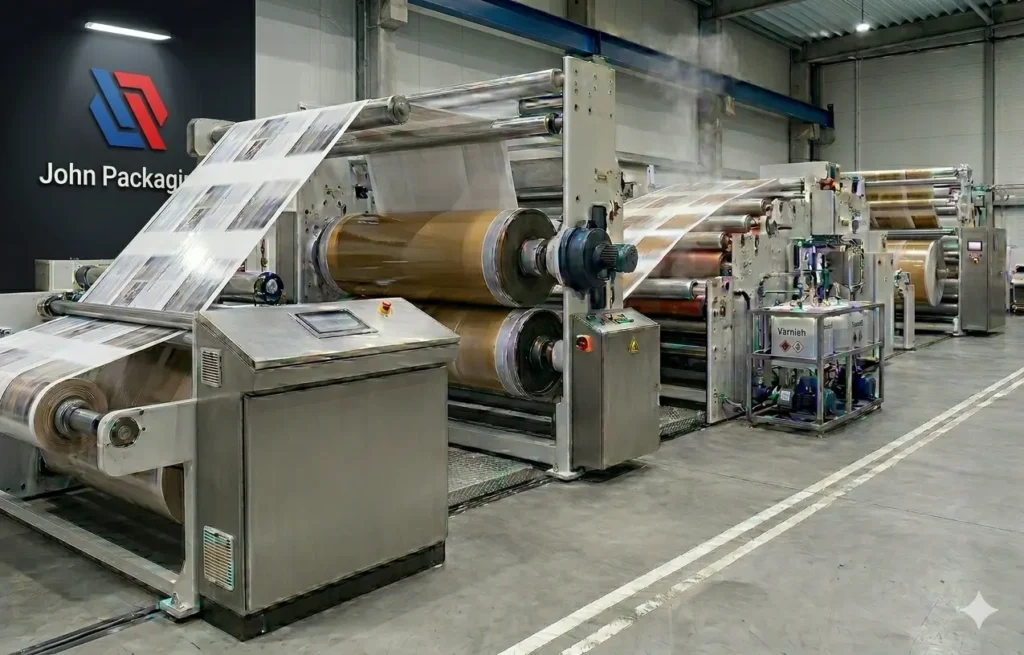
A Flexo press is an ink printing machine in flexographic printing that causes inked images to be transferred on various materials such as plastic film, paper, foil, and cardboard. The press involves the use of flexible printing plates that impress the surface of the material by using ink and printing designs on a rotating cylinder.
With Flexo printing, there are a number of elements that collaborate in printing. The ink is fed from an ink fountain and applied to an anilox roller, which regulates the quantity of ink to be issued. Anilox roller will then ink the flexible printing plate. As the plate turns, it forces the inked image onto the printing material to produce the printed design.
A Flexo printing press is typically constructed to include numerous printing units to be able to print one color, then another during a run. A unit uses different colors and multicolored designs, and full color images can be done effectively.
In the packaging industry, the common use of these presses is due to their ability to have high speeds and continuous rolls of material. Due to this fact, Flexo presses have been extensively used in the printing of labels, food packaging, plastic bags, and corrugated boxes.
The difference between Flexographic printing and offset printing?
Flexographic and offset printing are commonly used in commercial printing techniques, which are, however, different in terms of printing process, materials, and use.
-
Printing Method? ?
Flexographic printing involves flexed plates as the images in the print are formed by moving the plates onto the surface of the print, and then the images are transferred onto the print surface. The theory of offset printing is that ink and water are not soluble. The picture is then transferred to a plate, to a rubber blanket, and then to the printing paper.
-
Printing Surfaces
Flexographic printing may be used in printing a wide range of materials that include plastic films, foil, paper, cardboard, and other flexible materials. Offset printing is mostly applied to plain paper surfaces like books, brochures, and newspapers.
-
Ink Types? ?
Flexographic printing is usually done using water-based, solvent-based, or UV-curing ink, which is dry in a relatively short period of time. Inks of the petroleum-based offset printing are not fast-drying.?
-
Printing Speed
Flexographic printing is geared towards exceptionally high production rates and can be applied in the continuous printing of material roller. Offset printing is slower and yields rather sharp and detailed images in general.
-
Common Uses? ?
Mainly, flexographic printing is applied in the packaging of foods (labels, plastic bags, wrappers) and corrugated boxes. Paper products such as books, catalogs, magazines, and marketing materials are common products that may be offset printed.
-
Print Quality? ?
The color wars and the level of detail tend to be higher with offset printing, and thus, it is appropriate where quality images are required. Flexographic printing is very effective with packaging and can have fewer details than offset.
Generally, flexographic printing is an option for packaging and flexible materials, but offset printing is utilized in most cases when the quality of material is to be printed on paper.
FAQs: ?
Which printing method should we use on packaging Flexo? ?
Flexo printing is possible with flexible materials, fast production, and high volumes, which is why modern packaging and labeling should be implemented with the use of Flexo printing.
Are there any multi-color designs for flexographic printing? ?
The Flexo presses do have multiple colors applied in one printing run, as there are several printing units that permit the use of different colors in one run, thus the packaging can be designed in full color.
Is flexographic printing friendly to the environment? ?
Flexographic inks are water-based, and the current press technology minimizes environmental effects like emissions and solvents; thus, the flexographic printing technique is more of a greener form of printing as opposed to a few others.
?Are Flexo printing limitations being presented? ?
Flexography can be less detailed than offset printing, and plate making can be very expensive. It is most applicable when it is a large-volume run.
Is it possible to use Flexo printing to do short runs? ?
Although mainly applied to high-volume production, new Flexo presses can efficiently process small-scale production with a digital system of plate-making technology.